Sauteed Burgers and Vegetables

Vege Burgers 2

I made this meal as my post-workout meal and I honestly can’t get enough of it. It’s packed with protein, good fats, and it’s filling… Just what I like for a good post workout meal!

All you need is:
2 Burger Patties (I did Vege Burgers)
2 cups of Raw Spinach
1 cup of Baby Portabella Mushrooms
1/2 cup of Chopped Onions
1 Egg
Extra Virgin Olive Oil or Coconut Oil

1. Lightly grease a pan with cooking spray or coconut oil.
2. Place the two burger patties in the pan and sautee until ready. (I used Vege burgers which take 6-8 minutes to cook in a pan. Other burger patties have different cooking times. Make sure to check the recommended cooking time for the patties you are using)
3. In a separate pan, heat 2 tbsp of extra virgin olive oil on medium heat
4. Add the 1 cup of baby portabella mushrooms and a 1/2 cup of chopped onions to the pan.
5. Sautee the vegetables until they start to get a golden brown color. (5-7 minutes)
6. Remove the sauteed vegetables onto a plate that is covered with a paper towel (This will help soak up extra unneccessary oil).
Vege Burgers 1
7. Gently wash and wet the 2 cups of raw spinach
8. Once the burger patties are done, remove the patties from the pan and put them on a plate. Put the damp spinach in this now empty pan that the burgers were once in.
9. Cook the spinach until its begins to turn dark green and shrink. (If the pan is hot, this should only take 30 seconds-1 minute)
10. Place the cooked spinach on top of the burgers, and add the sauteed vegetables on top of that.
11. In a pan, grease and fry 1 egg.
12. Add the egg on top of the vegetables and enjoy!

If you use vege burgers like I did, this meal comes to about 35g of protein and 22g of carbs. If you decide to use meat burger patties instead of vege burger patties, it will raise the protein by about 6g per patty, your carb intake will lower about 7g per patty, and your fat intake will rise depending on the cut and fat percentage of the meat! Meat patties are perfect for those who may be on a low carb diet because the entire meal will then contain less than 8g of net carbs.

Like this recipe? Have any recipe ideas of your own? Any questions or comments? Email me at corestrengthblog.wordpress.com!

BOSU Ball Squats

Bosu Ball Squat - Position 1

Bosu Ball Squat – Position 1

Want to tone your legs? Want to challenge yourself with something new… Try BOSU Ball Squats.

This exercise is excellent to activate all of the muscles in your upper legs and your core. It requires a lot of control and balance and is a bit harder than it looks. To perform a BOSU Ball Squat:

    1. Grab a BOSU ball and put the ball on the ground, leaving the flat surface up.
    2. Slowly place one foot at a time on the BOSU ball and stand up straight (You are now in Position 1).
    3. Slowly lower to a squat position by lowering your butt down and activating your quads (You are now in Position 2)
    4. Using your quads, hamstrings, and glutes, raise back up to a standing position (You should now be back in Position 1).
    5. Repeat for the recommended amount of reps (usually 12-20).
Bosu Ball Squat - Position 2

Bosu Ball Squat – Position 2

Tips:

    1. Remember, when doing squats, the general rule is “Ass to Grass!” Lower your butt down as far as you can. This full range of motion will help build and tone your legs muscles.
    2. In order to balance, really activate your core. This exercise is more than just a leg workout!
    3. Once you become comfortable, you can add a barbell to make the exercise harder. Rest the barbell behind your head on your shoulders and perform the exercise with this added weight. WARNING: Do not try to squat the same amount of weight on the BOSU ball that you normally do on the flat ground. Start off small and add weight slowly. You will be surprised how much harder the squat becomes on the BOSU ball.
    4. BE CAREFUL!!! It is easy to fall off the ball. If you need to, perform this exercise next to a wall or something else that you can hold to maintain your balance. Try and do the exercise without brasing yourself, but hold something when necessary… Safety is always the most important thing when exercising!

Do you like this exercise? Do you have any other exercises you would like to share? Any questions or comments? Contact me at corestrengthalec@gmail.com

Workout: Outside Body Weight Workout 4/6/13

When traveling, sometimes it is hard to really find the time and place to get in a good workout. Today we experienced exactly that. DO NOT LET THIS BE AN EXCUSE TO DO NOTHING!!!!! Right now I am in Albuquerque, New Mexico and the weather could not have been more perfect for a workout. With little time and little equipment, my fellow cast members and I put together a quick circuit training workout that we could do outside just using our body weight. All you need to perform this workout is a bench, wall, or other object that is a foot or two off the ground. Here it is:

Alec Varcas Circuit Training

20 pushups
20 tricep dips
15 burpees
15 box jumps
10 squats
60 second plank hold
Sprint around the pool

We did this circuit 5 times!

The goal was to do this as fast as possible with very little breaks. It doesn’t sound too hard when you read through the workout, but once you get your heart rate going and you really push yourself to finish quickly, you will definitely SWEAT and your muscles will be screaming!

TIPS:
1. If you have never done any of these workouts, please do proper research and make sure your form is correct and safe! I will be posting some techniques for these workouts in the near future, so keep an eye out.
2. Circuit Training workouts are great to do with a group of friends. Seeing others push themselves hard, only makes me want to push my limits too. Plus if you are competitive, you can see who is able to finish the workout first!
3. BRING WATER! Circuit training can be very hard and if you do not hydrate, you are chancing dehydration which is never a good thing!
4. Push yourself. If you find this workout too easy, make it harder! You can add 10 more pushups, 10 more box jumps, 10 more squats, or even add more workouts to the circuit!

After this workout I realized that I did have a little more time so I also did 3 sets of:
20 belt kicks
60 second side plank holds on each side
40 power squats
30 pushups

All of these workouts together make up a great, quick full body workout. I usualy like to focus on one or two muscle groups a day, but it is great to mix it once in a while. Circuit training provides great cardio while also building and toning your muscles.

Do you have any circuits you like to do? Sent them to me! Maybe I will try them out and post them :-). Do you have any other questions? Email me at corestrengthalec@gmail.com.

Leg Lifts with Alternating Stability Ball

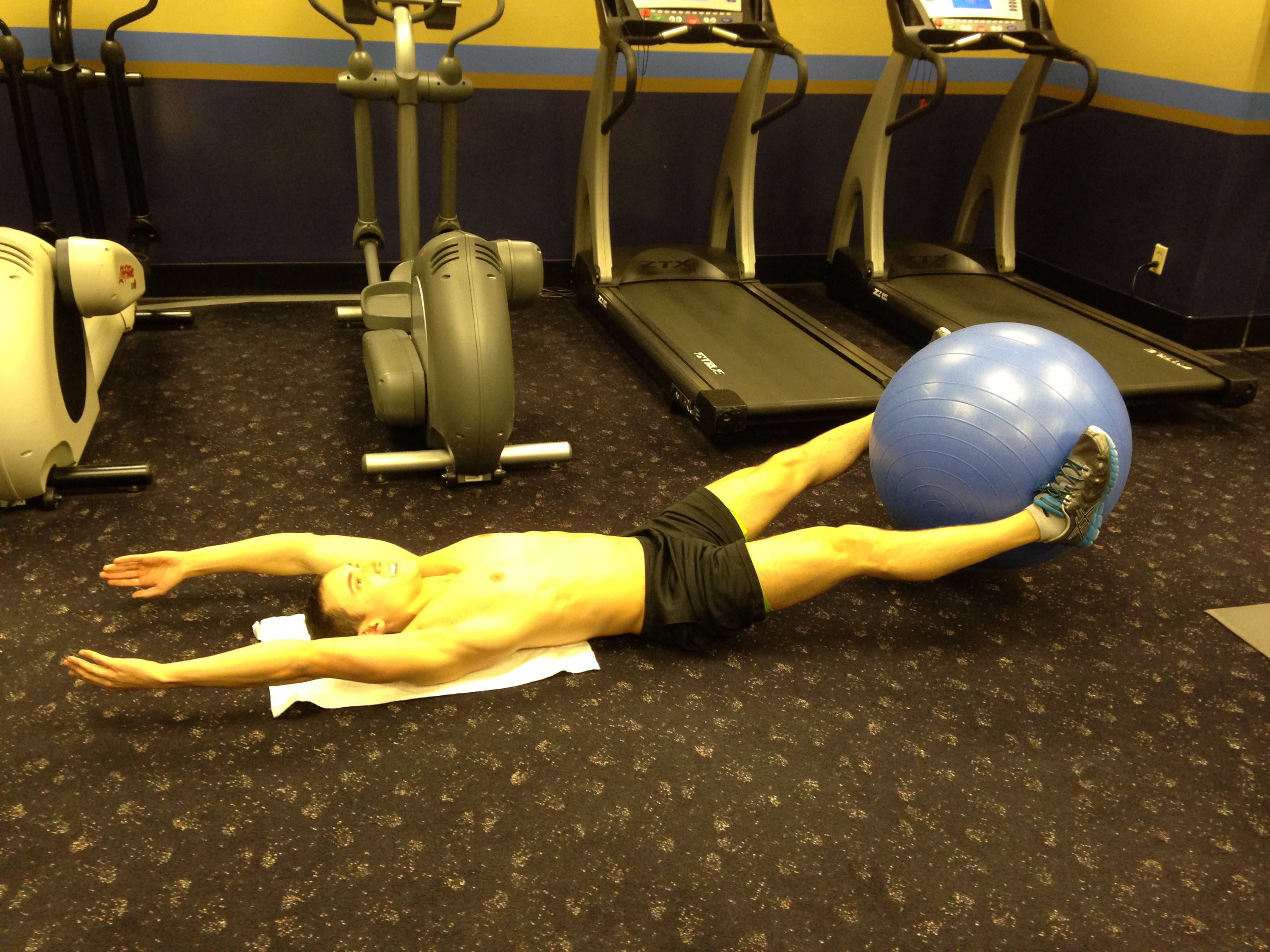
I obviously like to use the stability ball in many of my core exercises and this exercise is no different. I like to do this exercise almost every time I do a core workout! I can feel it really working and strengthening my entire core from my upper abs, to my lower abs, obliques, and even lower back! Similar to the regular leg lift exercise with the stability ball I posted a few days ago, this exercise adds more difficulty to the standard leg lift exercise and really helps tone the “V” cut in your lower ab/hip region.

Leg Lift (w. alt. stability ball) - Position 1

Leg Lift (w. alt. stability ball) – Position 1


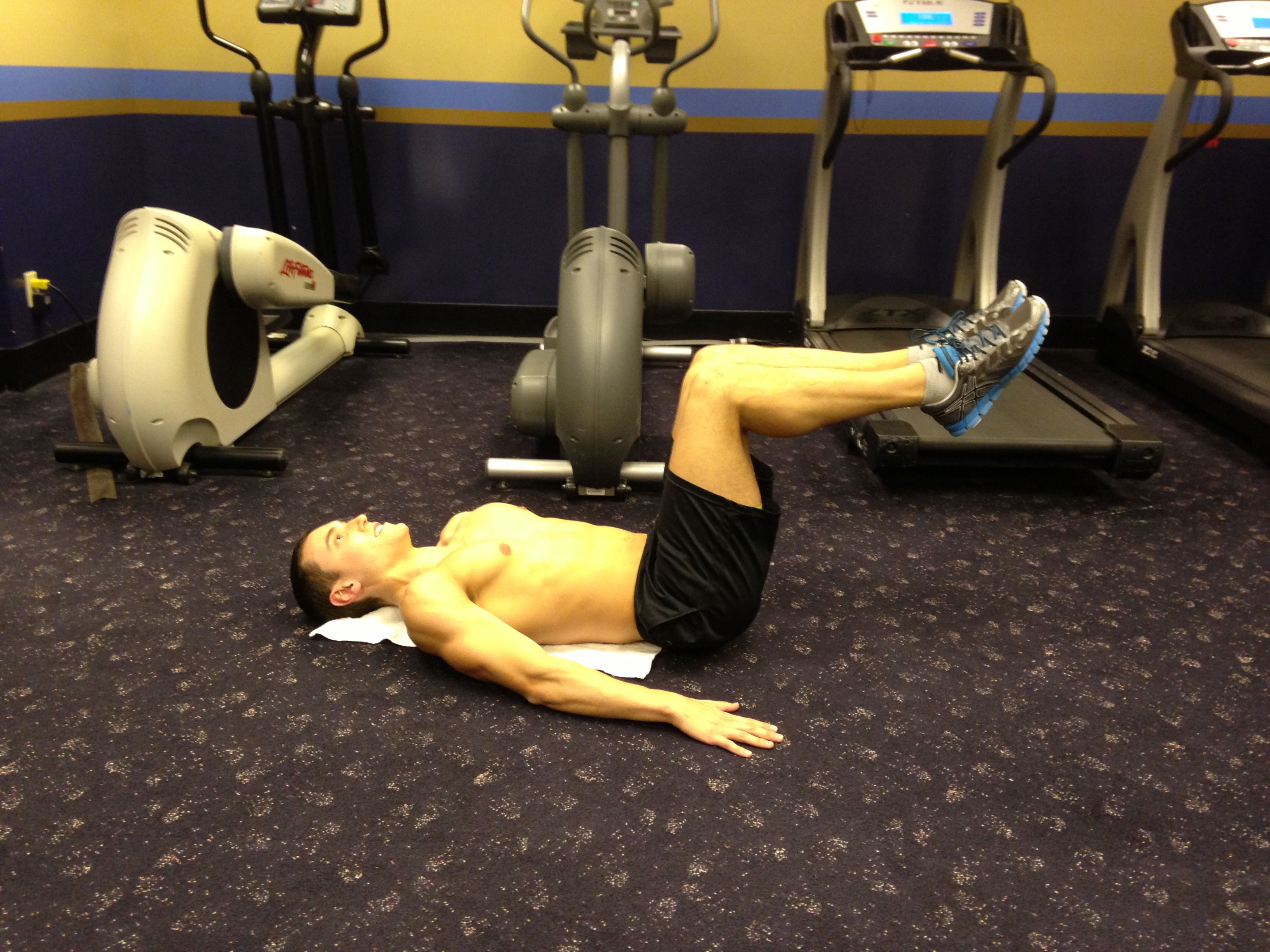
Leg Lift (w. alt. stability ball) - Position 2

Leg Lift (w. alt. stability ball) – Position 2


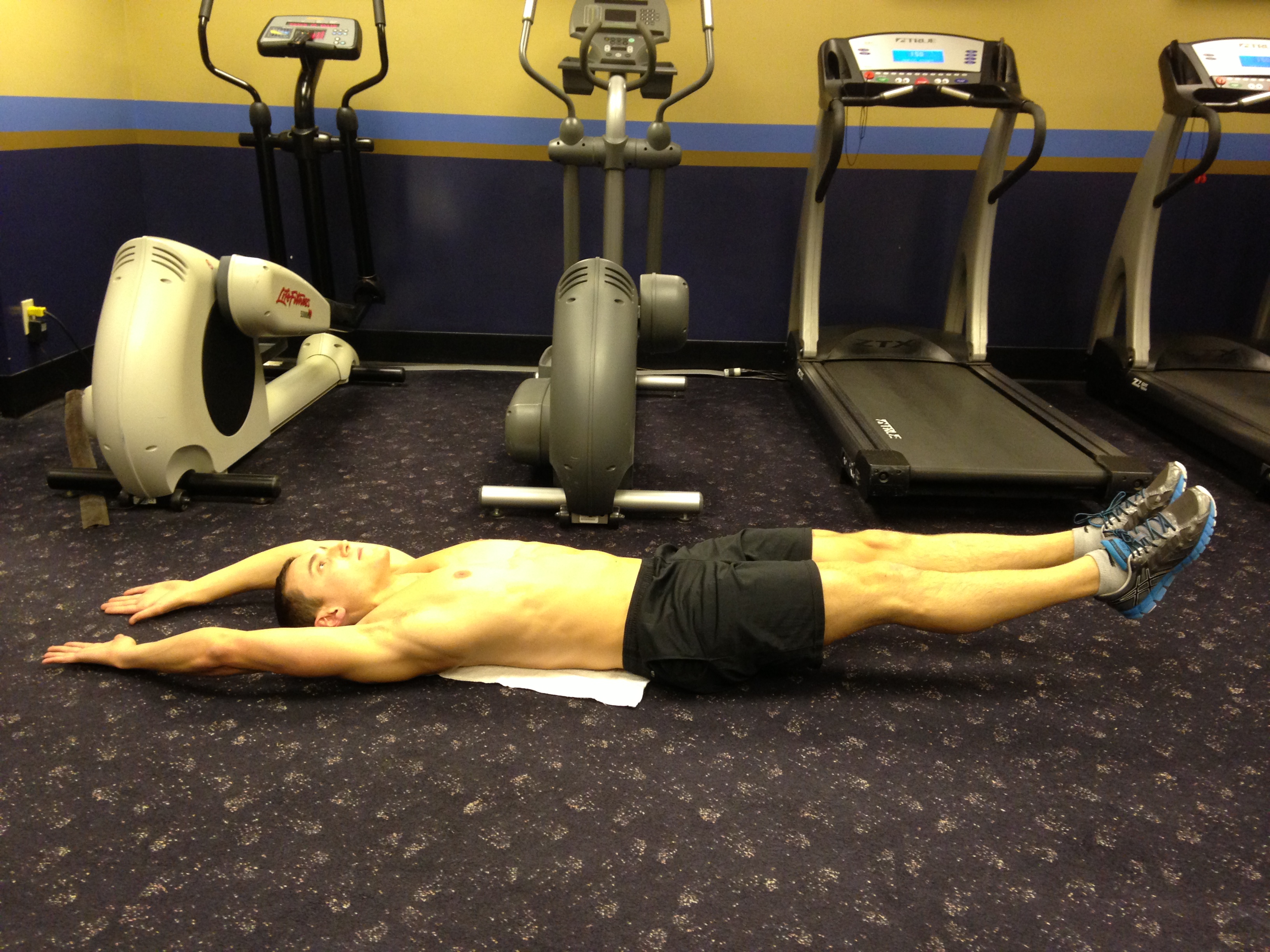
Leg Lift (w. alt. stability ball) - Position 3

Leg Lift (w. alt. stability ball) – Position 3


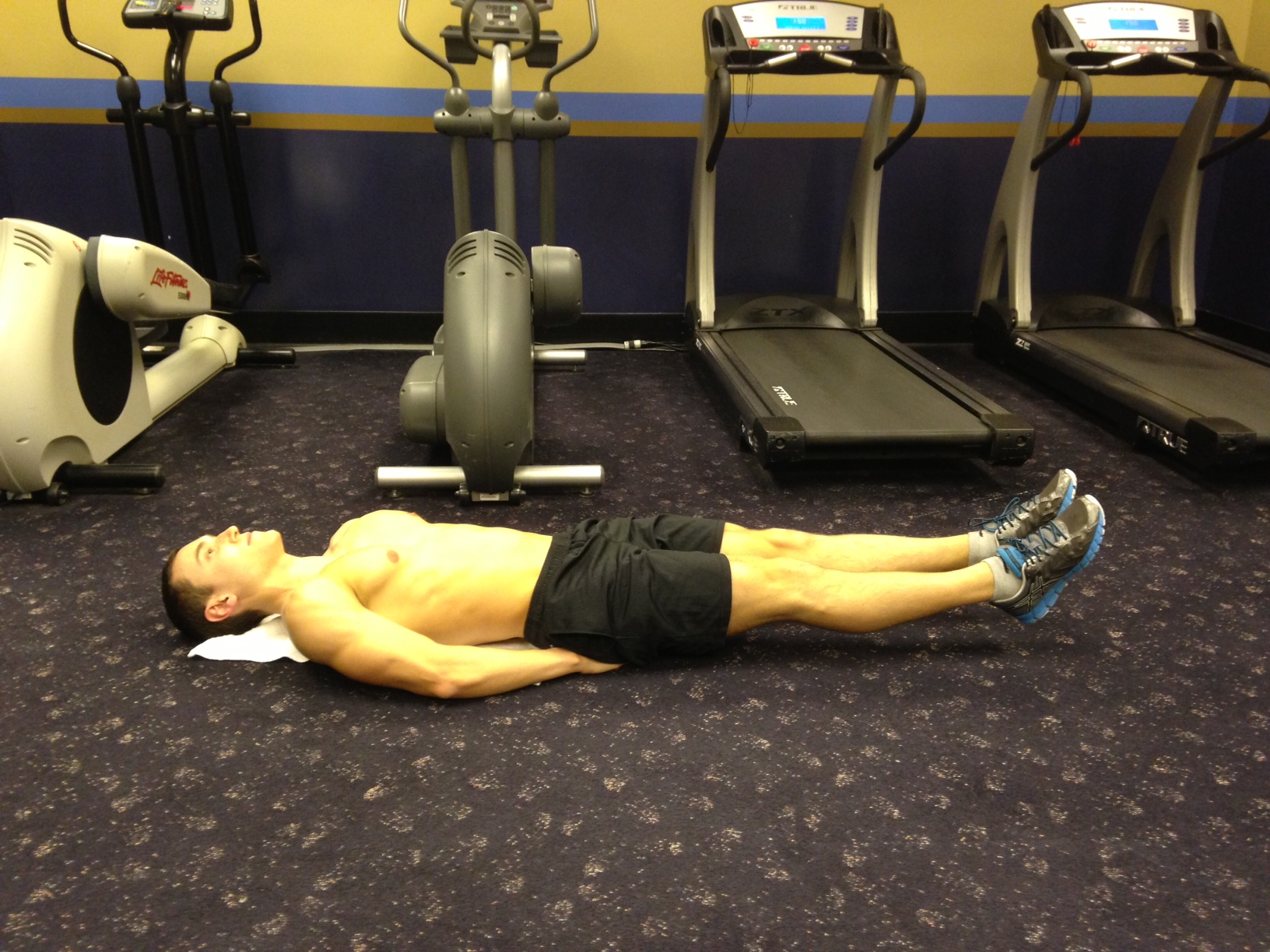
Leg Lift (w. alt. stability ball) - Position 4

Leg Lift (w. alt. stability ball) – Position 4

To Perform a Leg Lift with Alternating Stability Ball:

    1. Lie flat on the ground with a stability ball between your feet.
    2. Extend both arms straight back behind your head.
    3. With the stability ball between your feet, raise the stability ball a few inches off the ground (Now you are in Position 1 as shown in the first picture to the right).
    4. While still squeezing the stability ball between your feet, lift your legs up so the stability ball is above your lower torso and lift your arms to touch and grab the stability ball (You are now in Position 2 as shown in the second picture to the right).
    5. Grab the stability ball with your hands, and let go of the stability ball with your feet.
    6. Bring the stability ball back behind your head so that it is a few inches off the floor while lowering your legs back down, leaving your feet a few inches off the floor. (This is Position 3, shown in the third picture to the right).
    6. While still holding the stability ball in your hands, raise the ball back up over your toso and raise your legs straight up to wrap around the sides of the stability ball (You are now in Position 4 as shown in the fourth picture to the right).
    7. Switch your grip of the stability ball from your hands to your feet.
    8. While squeezing the stability ball between your feet, lower your legs back down having the stability ball only a few inches off the floor and lower your arms back behind your head. (You have now returned back to Position 1)
    9. Repeat the exercise for the recommended amount of reps (I usually do three sets of 15 reps).


Tips:

    1. When lowering your legs, both with and without the stability ball, it is important to activate your core and keep your back flat on the ground. Try not to create any sort of arch in your back during this exercise
    2. Try to make this exercise one fluid motion; don’t do each position one at a time. Instead, flow through the motions and make them nice and controlled.
    3. Exhale while lowering your legs down toward the floor.
    4. If you have never tried this exercise before, first try doing the exercise without the stability ball. If you can comfortably perform the exercise, then add the stability ball into your workout.
    5. Start with 8-10 reps of this exercise and work on reaching more reps as your core becomes stronger.
    6. To increase the intensity of this workout, you can also wear ankle/wrist weights for increased resistance.
    Hope you enjoy this exercise as much as I do. Let me know if you end up using it in your core workout routine. Have any questions or concerns? Email me at corestrengthalec@gmail.com

Leg Lifts with Stability Ball

Leg Lift (w. stability ball) - Position 1

Leg Lift w. stability ball – Position 1

This is another variation of a leg lift that I personally love doing in tandem with the Reverse Crunch exercise with the Stability ball (Click Here to see the Reverse Crunch stability ball exercise). Using the stability ball adds some resistance to the traditional leg lift which will activate your core muscles and your hips flexors. This exercise specifically helps target your lower abs and help create that “V” cut in your lower ab/hip region.

To Perform a Leg Lift with a Stability Ball:

    1. Lie flat on the ground with a stability ball between your feet.
    2. Place both hand at your sides (Make sure to keep your back flat on the ground).
    3. While squeezing the stability ball between your feet, raise the stability ball a few inches off the ground (Now you are in Position 1 as shown in the picture above).
    4. While still squeezing the stability ball between your feet, lift your legs up to create a 90 degree angle with the floor (You are now in Position 2 as shown in the picture below).
    5. Lower your legs back down to Position 1 with the stability ball a few inches off the ground.
    6. Raise and lower your legs between Position 1 and Position 2 for the recommended amount of reps (I do 3 sets of 15 reps).
Leg Lift w. stability ball - Position 2

Leg Lift w. stability ball – Position 2

Tips:

    1. As I said earlier, this is an exercise I like to do an tandem with the Reverse Crunch stability ball exercise. I usually do 25 reps of the reverse crunch exercise straight into 15 reps of the leg lift exercise, both using the stability ball. This gives my core a nice burn!
    2. Keep your back flat on the floor during this entire exercise. It is common to want to lift your lower back off the floor, but in order to target your core muscles to their fullest potential, your traps all the way down to your tailbone should be on the floor.
    3. Exhale while lowering your legs from Position 2 to Position 1 to activate your abdominals.
    4. You must use controlled motions during this exercise! Focus on using your core muscles to lift the stability ball.
    5. Try holding your legs in Position 1 for a second before raising your legs to Position 2. This will increase core strength and cause you to activate your core muscles affectively.
    6. If you are just beginning this exercise, first try doing Level 1 leg lifts. If you can comfortably perform level 1 leg lifts, move on to try level 2 and level 3 leg lifts. If you can perform those exercises, then move on to this exercise with the stability ball. This exercise is definitely harder than the other variations of leg lifts so start with 8-10 reps of this exercise and work on reaching more reps as your core becomes stronger.

Hope you enjoy this exercise as much as I do. Let me know if you end up using it in your core workout routine. Have any questions or concerns? Email me at corestrengthalec@gmail.com

Reverse Crunch (with Stability Ball)

A few days ago, I posted an exercise I frequently do called the Reverse Crunch. That exercise is great for core strength and toning, but when I am at a gym, and there is proper equipment around, I like to mix things up a bit. This following exercise is the same as a Reverse Crunch, but you use a stability ball to add some difficulty. The stability ball adds a small amount of resistance, and it also forces you to use better form. You must tightly squeeze your abdominals in order to lift the ball from the ground and it also does not allow your legs to sway too far from a proper position.

Reverse Crunch (w. ball) -  Position 1

Reverse Crunch (w. ball) – Position 1


Reverse Crunch (w. ball) -  Position 2

Reverse Crunch (w. ball) – Position 2

To perform a Reverse Crunch with a Stability Ball:

    1. Find a stability ball that allows you to rest your legs on top while creating a 90 degree angle at your hips and your knees (your calves and feet will be resting on the ball, parallel to the floor).
    2. Lie flat on your back with your hands at your sides.
    3. Place the Stability ball under your calves, resting against the back of your hamstrings. Your knees should only be a few inches apart.
    4. Squeeze your abs and legs in order to lift the stability ball slightly off the floor (You are now in Position 1 as shown in the first picture to the right).
    5. While squeezing the stability ball, raise your knees to your chest.
    6. While in motion of bringing your knees to your chest, roll your pelvis back and raise your hips up off the floor, creating a curve in your spine (You are now in Position 2 as shown in the second picture to the right).
    5. Hold Position 2 for a second and squeeze your abdominals.
    6. Slowly lower your legs and pelvis back down to Position 1.
    7. Repeat the exercise for the recommended amount of reps (I usually do 3-5 sets of 15 reps).

Tips:

    1. Just like any serious ab exercise, control is important! These motions do not depend on momentum, but rather slow controlled motions that engage your muscles.
    2. If this exercise is too difficult, I recommend starting with Reverse Crunches without the Stability Ball. I give step by step directions on how to perform this exercise here: Click Here
    3. Notice that when lowering my legs back down to Position 1, I try not to let the ball touch the floor; this will keep your core activated the entire exercise. If you need to take a break mid-exercise, lower the ball to the floor completely, and when ready, lift the ball off the floor again.
    4. Another possible variation of this exercise, that I find a bit easier to do, would be to have your knees further apart on the ball. The wider your knees are from each other, the easier this exercise appears to be.
    5. Make sure to exhale while bringing your legs up into your chest (from Position 1 to Position 2), and inhale when returning your legs back down to Position 1.
    6. Squeeze your abdominals when you hit the peak of Position 2. You should feel a burn in your entire core.
    7. If you are performing this exercise on a mat, DO NOT hold the edge of the mat. Leave your hands flat on the ground, and depend solely on your abdominals to perform this exercise.
    8. You will notice that it is common for the ball to slip from your legs during this exercise. Try your hardest to keep it in place. If it does move, simply use your hands to get it back into a proper position and continue the exercise.
    9. Stability balls come in all different sizes. Try to find one that allows you to make a 90 degree angle at your hips and knees, letting your calves and feet lie parallel to the ground while resting on top of the ball.

Let me know what you think of this new variation of the Reverse Crunch. I hope you like it! If you have any questions or concerns, email me at corestrengthalec@gmail.com

Reverse Crunch

For this blog, I like steering away from conventional situps and crunches because those are exercises I have done for years and almost everybody has tried a basic situp or crunch. Although they definitely still help strengthen your core, I would like to give you some workouts that you may not have seen or tried before to help amp up your core workout routine.

This following exercise is a Reverse Crunch. It targets your core very well and when done correctly you can really feel the squeeze in your abdominals.

Reverse Crunch -  Position 1

Reverse Crunch – Position 1


Reverse Crunch -  Position 2

Reverse Crunch – Position 2


To perform a Reverse Crunch:

    1. Lie flat on your back with your hands at your sides.
    2. Raise your knees to create a 90 degree angle at your hips and at your knees, leaving your feet parallel to the ground (You are now in Position 1 as shown in the first picture to the left).
    3. Pull your knees in towards your chest.
    4. While in motion of bringing your knees to your chest, roll your pelvis back and raise your hips up off the floor, creating a curve in your spine (You are now in Position 2 as shown in the second picture to the left).
    5. Hold Position 2 for a second and squeeze your abdominals.
    6. Slowly lower your legs and pelvis back down to Position 1.
    7. Repeat the exercise for the recommended amount of reps (I usually do 3-5 sets of 25 reps).


Tips:

    1. Controlled motions are needed for this exercise. Do not depend on momentum to get our legs up and down. Engaging your lower abdominals to raise your legs and activating your entire core to perform slow controlled motions is how you will see and feel results.
    2. BREATHE!!! Your breath during this exercise will help activate your muscles. Make sure to exhale while bringing your legs up into your chest, and inhale when returning your legs back down to Position 1.
    3. Make sure to squeeze your abdominals when you hit the peak of Position 2. You should feel a burn in your core.
    4. If you are performing this exercise on a mat, do not hold the edge of the mat. Leave your hands flat on the ground, that way you will have to depend strictly on your abdominals to perform this exercise.

I hope you like this new exercise. Let me know what you think. If you have any questions or concerns, email me at corestrengthalec@gmail.com

Leg Lifts (Level 2 & Level 3)

The following exercises are the Level 2 and Level 3 versions of the Leg Lifts I posted the other day. Although very similar to the Level 1 version, the Level 2 and Level 3 Leg Lifts are harder to perform. The only difference between the exercises is where you place your hands, but you will realize that the placement of your hands can strongly affect the impact of the exercise.

Leg Lift (Level 2) - Position 1

Leg Lift (Level 2) – Position 1


Leg Lift (Level 2) - Position 2

Leg Lift (Level 2) – Position 2

To Perform a Level 2 Leg Lift:

    1. Lie flat on the ground with your feet together.
    2. Place both hands flat on the ground at your sides (Make sure to keep your back flat on the ground).
    3. Raise your feet 4-6 inches off the ground (Now you are in Position 1 as shown in the first picture pn the left).
    4. With your feet together and legs as straight as possible, lift your legs up to create a 90 degree angle with the floor (You are now in Position 2 as shown in the second picture on the left).
    5. Lower your legs back down to Position 1 with your feet a few inches above the floor.
    6. Raise and lower your legs between Position 1 and Position 2 for the recommended amount of reps (I do 3 sets of 25 reps).


Leg Lift (Level 3) - Position 1

Leg Lift (Level 3) – Position 1


Leg Lift (Level 3) - Position 2

Leg Lift (Level 3) – Position 2

To Perform a Level 3 Leg Lift:

    1. Lie flat on the ground with your feet together.
    2. Raise your arms above your head extending to the wall behind you.
    3. Raise your feet 4-6 inches off the ground (Now you are in Position 1 as shown in the first picture on the right).
    4. With your feet together and legs as straight as possible, lift your legs up to create a 90 degree angle with the floor (You are now in Position 2 as shown in the second picture on the right).
    5. Lower your legs back down to Position 1 with your feet a few inches above the floor.
    6. Raise and lower your legs between Position 1 and Position 2 for the recommended amount of reps (I do 3 sets of 25 reps with this variation as well).


Tips:

    1. You must keep your back flat on the floor during both of these exercise. Form is the most important aspect of these exercises, and if you are not able to perform this exercise, please try doing Level 1 Leg Lifts first to help strengthen your core and prepare yourself for these more advanced variations.
    2. Exhale while lowering your legs from Position 2 to Position 1. This will help activate the correct muscles
    3. CONTROL CONTROL CONTROL!!!! All motions must be as controlled as possible. Fast sloppy motions will not make this exercise affective.
    4. To increase core strength, hold your legs in Position 1 with your feet a few inches off the floor for a second before raising your legs to Position 2.
    5. Specifically for Level 3 Leg Lifts, keeping your hands above your head will assist in stretching out your core giving your abdominals a nice extensive workout.

Hope you find these two new variations helpful. Have any questions or concerns? Email me at corestrengthalec@gmail.com

Leg Lifts (Level 1)

Leg Lift (Level 1) - Position 1

Leg Lift (Level 1) – Position 1

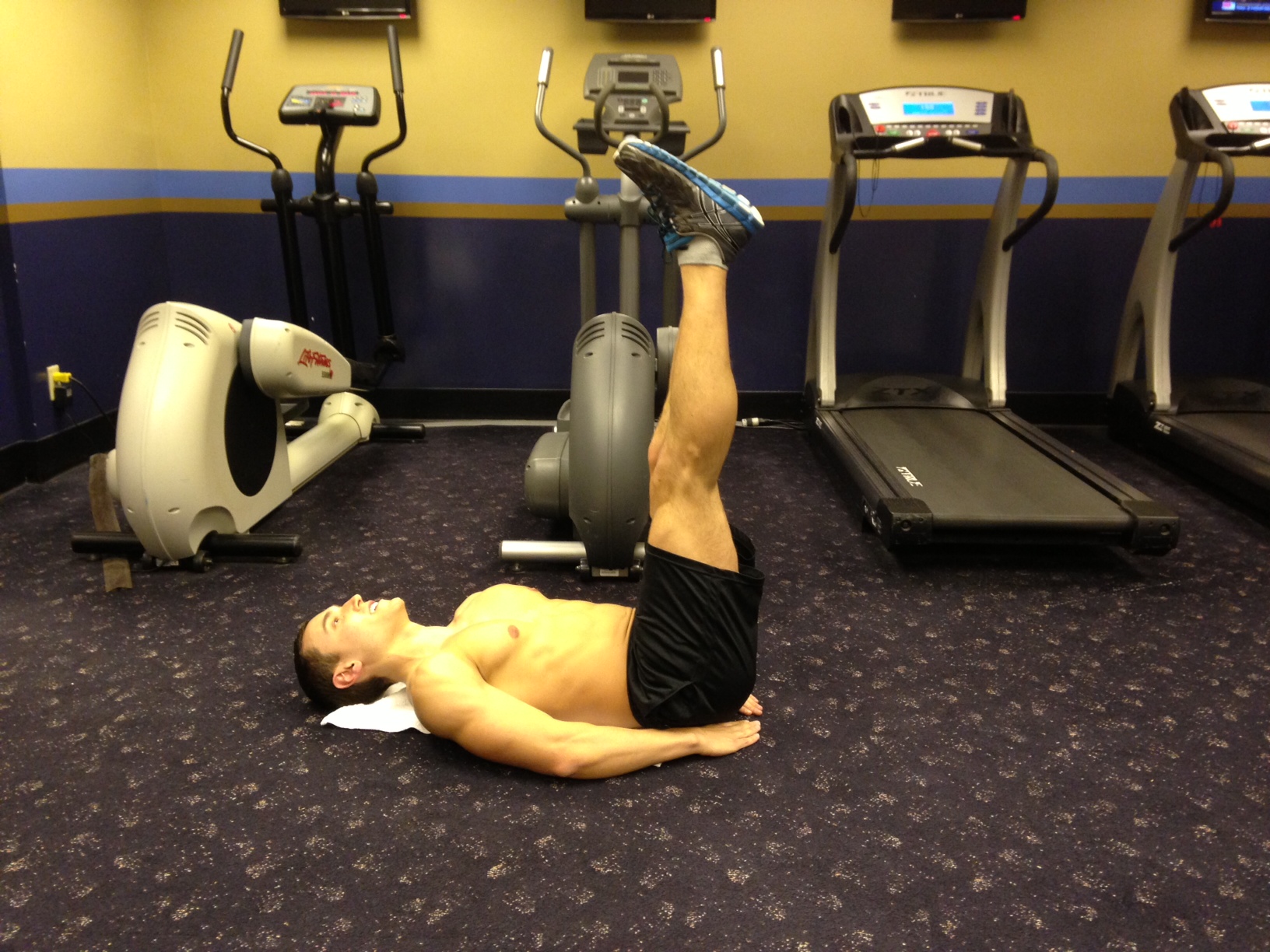
This exercise is excellent for targeting your core, specifically your lower abs. There are many variations to this exercise, but today I will start with the Level 1 variation. Once the Level 1 Leg Lift is mastered, you can then try moving on to Level 2, then Level 3, and so on. I will post some of the other variations in my upcoming posts.

To Perform a Level 1 Leg Lift:

    1. Lie flat on the ground with your feet together.
    2. Place both hand under your glutes, right below your tail bone (Make sure to keep your back flat on the ground).
    3. Raise your feet 4-6 inches off the ground (Now you are in Position 1 as shown in the picture above).
    4. With your feet together and legs as straight as possible, lift your legs up to create a 90 degree angle with the floor (You are now in Position 2 as shown in the picture below).
    5. Lower your legs back down to Position 1 with your feet a few inches above the floor.
    6. Raise and lower your legs between Position 1 and Position 2 for the recommended amount of reps (I do 3 sets of 25 reps).
Leg Lift (Level 1) - Position 2

Leg Lift (Level 1) – Position 2

Tips:

    1. You must keep your back flat on the floor during this entire exercise. There should be no curve in your back. The top of your spine down to your tail bone should be flat on the floor at all times during this exercise.
    2. Exhale while lowering your legs from Position 2 to Position 1. Doing this will activate your abdominals.
    3. Use controlled motions! DO NOT whip your legs up and down as fast as you can. Using slow controlled motions will make this exercise much more affective.
    4. Try holding your legs in Position 1 with your feet a few inches off the floor for a second before raising your legs to Position 2. This will really burn your abdominals and will help increase your core strength.
    5. If you are just beginning, try doing 10-15 reps of this exercise at first and see if you can comfortably perform this exercise. It is important to really push yourself in order to see results, but safety always come first. If you have to start with only doing 10 reps of this exercise, make it a goal to add one more rep every few times you perform this exercise until you reach 20-25 reps per set.

Hope you enjoy this exercise and keep a lookout for the other variations soon to come. Have any questions or concerns? Email me at corestrengthalec@gmail.com

Leg Pull-Ins/Leg Tucks (Level 1)

Leg Pull-In: Position 1

Leg Pull-In: Position 1

The Leg Pull-In is an exercise that specifically activates your upper, middle, and lower abs. The reason I really enjoy this workout is because anyone from a beginner to a professional fitness instructor can benefit from this exercise, and it also is a great transition workout to do between exercises.

To perform a Leg Pull-In:

    1. Find an open space on the floor.
    2. Lean slightly backward (about a 45 degree angle).
    3. Place your hands on the floor, behind your hips, with your fingertips facing forward (toward your legs).
    4. Keep your legs straight and raise them a few inches off the floor (You are now in position 1 of the exercise as seen in the picture above).
    5. While exhaling and tightening your abs, bring your knees toward your chest and raise your torso slightly toward your knees(This is position 2 of the exercise as seen in the picture below). Hold this position for about one second.
    6. Extend back out to position 1 and hold for one second.
    7. Repeat switching between Position 1 and 2 for the determined amount of reps (I usually do about 20 reps).

Leg Pull-In: Position 2

Leg Pull-In: Position 2


Tips:

    1. Exhale while bringing your knees in. When exhaling you will be able to tighten and activate your abs more effectively.
    2. If you are new to this workout, try doing between 5-10 reps, and then increasing the amount of reps you do per set once you become stronger.
    3. This exercise can also be done on a bench or seat. Simply place your hands on the edge of the bench/seat and extend your legs out.
    4. This is one of my favorite transition exercises to do between more intense exercises such as a bench press or shoulder press. This workout will help keep your heart rate up while only exhausting your core muscles and giving the other muscles you may be training some rest between sets.
    5. To increase the intensity of the workout, move your hands next to your hips instead of behind you. This will help activate your entire core more effectively.
    6. For more advanced people, you can add weight to the exercise by using weighted ankle wraps, placing a dumbbell between your feet, or using the cable machine and strapping the cables to your ankles. WARNING: Be very careful when adding weight to any ab workout. Adding too much weight before your body is ready can cause serious injury or hernias.

Hope you enjoy this workout! If you have any questions of concerns, contact me at corestrengthalec@gmail.com