Rolling Pistol Squats

Rolling Pistol Squat: Step 1

Rolling Pistol Squat: Step 2

Rolling Pistol Squat: Step 3

Rolling Pistol Squat: Step 4

Rolling Pistol Squat: Step 5

One of the benchmark exercises to do in any CrossFit gym is a Pistol Squat. Pistol Squats involve only using one leg to squat down and push back up to the standing position. This exercise is very difficult and requires a lot of practice and strength to complete. Rolling Pistol Squats are an easier variation of the standard Pistol Squat because they allow you to use momentum to your advantage. Rolling Pistol Squats are also a great cardio and full body workout.

To Perform a Rolling Pistol Squat:
1. Start in the standing position with both feet on the floor.
2. Squat down with your glutes as close to the floor as possible and create a comfortable curve in your back to prepare to roll backward.
3. Roll backward onto your back and raise your legs in the air.
4. Using the momentum of throwing your legs forward, place one foot on the ground as close to your glutes as possible with the other leg straight out in front of you and stand up.
5. Once standing, put the leg that is straight out in front of you back down to return to the standing position.
6. Repeat the exercise from Step 2 and alternate legs with each rep.

TIPS:
1. When I roll backward, I like to keep my legs straight and bring my legs as close to my chest as I can. I give them a light pull with my hands and this allows me to give my hamstrings a stretch.
2. The closer you can place your foot to you glutes when you role forward, the easier it will be to stand up.
3. Momentum is key! Quickly bring your legs forward to make the push up from the floor easier.
4. For anyone with a knee or hip injury, any variation of a pistol squat is not recommended. Never do a workout that causes you pain. Listen to your body!
5. Rolling Pistol Squats are great to help tone your legs, but they also wok your core and provide a good cardio workout as well. I like to use Rolling Pistol Squats in between other exercises to keep my heart rate up. I usually do about 16 reps per set (8 on each leg), and about 3-5 sets during my workout.

Have you ever tried Rolling Pistol Squats? Do you plan on adding these to your workout routine? I really appreciate any feedback. Contact me at corestrengthalec@gmail.com.

Jump Squats

Time to get our butts in shape for summer, LITERALLY. I personally can get bored with traditional cardio, so I try to integrate some High Intensity Interval workouts that not only provide a great cardio exercise, but also help tone your muscles. Jump squats are a great high intensity workout that target your entire lower body, especially your booty.

Jump Squat: Jump

Jump Squat: Squat

To perform a Jump Squat:
1. Start in a standing position with your feet about shoulder width apart.
2. Squat down.
3. From the squat position, jump up in the air and extend your legs. (Your feet should be a few inches above the ground)
4. Once you complete the jump, repeat the workout from step 2.

Tips:
1. When squatting down, get your glutes low to the floor. This will stretch and activate your muscles more effectively.
2. While jumping, straighten your leg and tighten your quads. Work your leg muscles even in the jump of the exercise.
3. When you return back to the ground, land through your toes and bend your knees. This promotes good form and prevents injury and joint discomfort.
4. I either like to do 5 sets of 15 reps for this workout with 45 second breaks in between, or I use this workout to superset with another leg exercise (usually lunges).

Are you getting your body in shape for the summer? Do you use Jump Squats in your routine? Contact me at corestrengthalec@gmail.com with questions, comments, or ideas for new topics.

BOSU Burpees

Back to BURPEES! I promised that I would show you other versions of Burpees and the one I am about to show you is one of my favorites. For this variation, you will need to use a BOSU ball. These BOSU Burpees intensify your workout by adding stability and resistance components to your burpee.

To do a BOSU Burpee:
1. Start in a standing position holding the BOSU Ball handles with the ball facing away from your body.
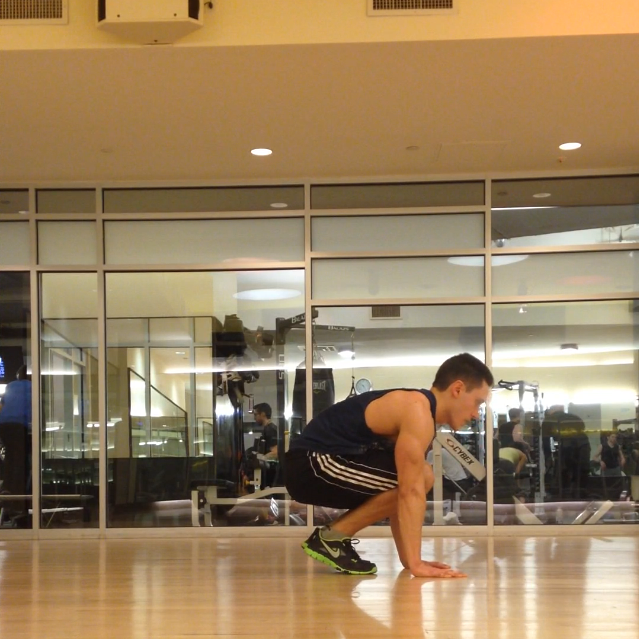
2. Squat down and place the BOSU ball on the ground. (The flat side should be facing up and the ball side should be on the floor)
3. Jump your feet back to put yourself in a plank position while still holding the BOSU ball handles.
3a. Optional Pushup
4. Jump your feet forward to return to the squat position.
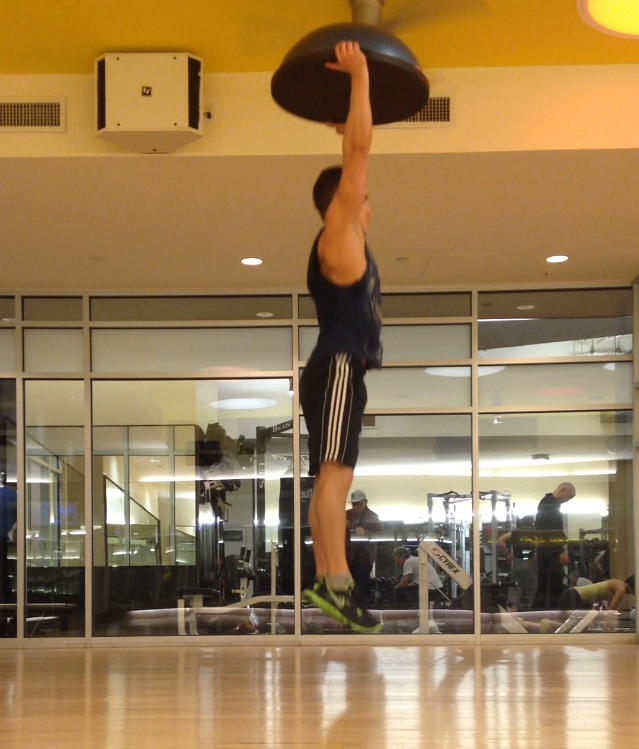
5. Raise the BOSU ball above your head.
6. Jump up. While jumping, press the BOSU ball up toward the ceiling.
7. Repeat from Step #1.

Tips:
1. If you are not familiar with Burpees, or forget some of the tips I have given to get the most out of these exercises, check out my ‘How to do a Burpee’ Post before trying this more difficult variation of the exercise. It is important to understand the body mechanics of the basic exercise before trying more difficult variations in order to prevent injury.
2. Remember, when squatting down, try and get your glutes low to the floor.
3. Activate your core while in the plank position. The BOSU Ball will add an additional stability aspect to the exercise which will require more core strength and activation than the Basic Burpee.
4. When jumping during this exercise, you also press the BOSU Ball up toward the ceiling. Adding the BOSU ball will not only add weight to your jump making the jump more difficult, but it will also help tone your shoulders while pressing the BOSU Ball up.

Bosu Burpee: Step 1

Bosu Burpee: Step 1

Bosu Burpee: Step 2

Bosu Burpee: Step 2

Bosu Burpee: Step 3

Bosu Burpee: Step 3

Bosu Burpee: Step 3a (optional pushup)

Bosu Burpee: Step 3a

Bosu Burpee: Step 3a (finish optional pushup)

Bosu Burpee: Step 3a

Bosu Burpee: Step 4

Bosu Burpee: Step 4

Bosu Burpee: Step 5

Bosu Burpee: Step 5

Bosu Burpee: Step 6

Bosu Burpee: Step 6


Do you any variations of Burpees that you like to include in your workout routine? Contact me at corestrengthalec@gmail.com for any questions, comments, or ideas for new topics.

How to do a Burpee!

BURPEES! You love them and you hate them.
Burpees are an amazing cardio workout and work many of your major muscle groups. Burpees are one of the best full body workouts you can do in your exercise routine, however it is also easy to do a burpee incorrectly, making the exercise not as effective.

To do a Basic Burpee:
1. Start in a standing position
2. Squat down and place your hands on the ground.
3. Jump your feet back to put yourself in a plank position.
4. Jump your feet forward to return to the squat position.
5. Jump up straight off the floor from the squat position.
6. Repeat from Step #1

There are many variations of Burpees. The most common variation is the Burpee Pushup where one pushup is done while in the plank position. (Between steps #3 and #4 of the Basic Burpee instructions, do a pushup).

Tips:
1. When squatting down, try and get your glutes low to the floor. This will make the exercise seem harder, but that is because you are activating most of the muscles in your legs from your quads, to your glutes and hamstrings. This muscle activation will help tone your legs more effectively.
2. While in the plank position, make sure to keep your body completely flat and activate your core. It is very easy to raise you hips and glutes up toward the ceiling.
3. When jumping during this exercise, and in any other exercise, land with bent knees. If you jump and land with your legs completely straight, you will put too much pressure on your knees and lead to injuries in the future.
4. Burpees can be done as a FT workout (For Time) or AMRAP workout (As Many Reps As Possible). If you do a FT workout, give yourself a certain number of burpees to do and see how much time it takes you to complete the workout. If you choose to do an AMRAP workout, give yourself an amount of time, usually a minute or two, and see how many burpees you can do in the time allotted.

Burpee: Step 3

Burpee: Step 3

Burpee: Step 2

Burpee: Step 2

Burpee: Step 1

Burpee: Step 1

Burpee: Step 5

Burpee: Step 5

Burpee: Step 4

Burpee: Step 4

Burpee: Step 3a (optional pushup)

Burpee: Step 3a (optional pushup)

Burpee: Step 6

Burpee: Step 6

Do you include Burpees into your workout? Do you have any variations that you would like to share? Contact me at corestrengthalec@gmail.com for any questions, comments, or ideas for new topics.

How to get the most out of your Calf Raises!

Calves2
Calf Raises can be done many ways; however, there are a few tips to understand and follow in order to get the most out of the exercise.

  • First of all DO NOT BOUNCE! When you bounce or do quick calf raises, the work is being done by your Achilles tendon, not your calf muscles. You may feel a burn in your calf muscle, but it is not being targeted well enough to see results.
  • Doing a slow controlled movement from a rest (standing) position to the balls of your feet will activate all of the muscles in your calves.
  • If calf raises are done with straight legs, all of the parts of the calf will be working, but most of the work will be done by the very visible, large muscle on the outer part of the calf (Gastrocnemius). This will promote thickness and definition of your calf. If calf raises are done with bent knees, the smaller muscle behind the Gastrocnemius (Soleus) will be doing most of the work. Now although the Soleus muscle is not as visible as the Gastrocnemius, because it is behind the larger muscle, it will cause the Gastrocnemius to swell and visibly pop out more. Both are beneficial so I like to alternate between bent and straight legs between sets.
  • Calf raises can be very effective with no weight; however if you are doing weighted calf raises, the same principle applies. Use slow controlled motions rather than a bouncing movement.
  • Another possible way to change up the exercise is doing calf raises on a ledge where your heels hang over the edge. When lowering, go past parallel with the floor and stretch your calf muscles more. This will give you a wider range of motion for the muscle; therefore working the muscle in a different, harder way.

The gym I currently go to has a Power Plate. I like to start off my calf routine with 3 sets of slow calf raises on the Power Plate, and then I do 4 sets of weighted calf raises on one of the calf machines. Do what works best for you, but make sure to follow these tips.

I hope you found this article helpful. If you have any questions, concerns, or ideas for other articles, please email me at corestrengthalec@gmail.com

Is Shoveling Snow a Good Exercise?

shoveling-snow2
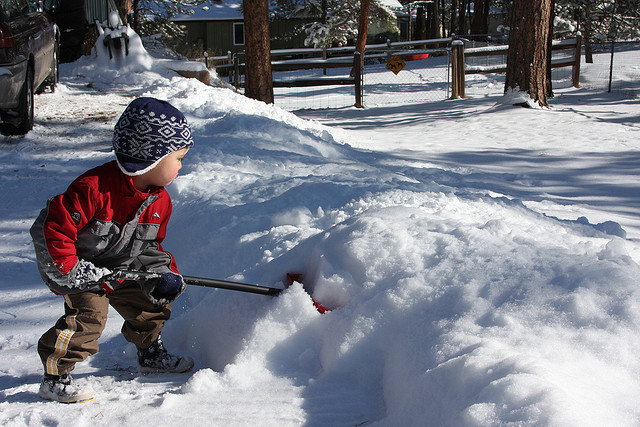
Because Winter is now upon us, and we are definitely starting to see some heavy snowfall, I wanted to see if shoveling snow was a good way to get some exercise. I personally always dreaded going outside and clearing the driveway of snow, but after doing some research, I realized that it definitely has its benefits. According to an article done by Julie Garden-Robinson, Ph.D., L.R.D, at North Dakota State University, a person of 170lbs can shovel for 30 minutes and burn about 250 calories. (Click Here to See the Article) Because shoveling involves high repetitions of lifting a weighted object, it also can help tone your muscles in your arms, legs, and core if done correctly. Not too bad for a chore I hate doing.

shoveling-snow

It is important to also understand the dangers of shoveling before you go out and start throwing the snow around. A quote from masslive.com stated,

“According to a study published in the American Journal of Emergency Medicine, some 195,100 Americans were treated in emergency rooms for snow shoveling-related mishaps from 1990 to 2006. Among those cases, 7 percent were cardiac related, which made up all of the 1,647 deaths in the study.”

Click Here to see the Article on Masslive.com

Here are some tips to keep in mind:

  • Because shoveling can involve some heavy lifting at times, it also puts some people at risk of heart attacks. If you already have high blood pressure or are at risk of a heart attack, consult your doctor before you decide to go outside and shovel snow.
  • Make sure to always lift with your legs and tighten your core when lifting the snow.
  • Avoid twisting and lifting from your lower back to avoid lower back injuries which are common when shoveling.

So next time you go out to battle the cold and shovel, try to think of how it actually can help you reach our fitness goals. As long as you stay smart and safe by following the tips I shared, shoveling will can be more than just a chore, but a productive workout.

How did you like this post? Did you find it useful? Do you have any other ideas for future posts I should do? If you have any questions, comments, or concerns, feel free to contact me at corestrengthalec@gmail.com.

Do You Hate Running? Try Running In Reverse!

Ever since I was a kid, I never liked running. I didn’t mind playing a game of tag or running to a base during a kickball game, but when it came to long distance running, I never excelled… I flat out stunk at it. Friends of mine today keep telling me how they are preparing for different races, and all I can think about is how I can’t even stay on a treadmill for 10 minutes without wanting to pass out. I have tried entering races, running with friends, and even running with my dog, but I still can’t keep up. I have always wanted to reach that ‘runners high’ people talk about when they can just run for hours and just enjoy it, but no matter what I do, I have not been able to find a method that works for me… Until now!

Backward running
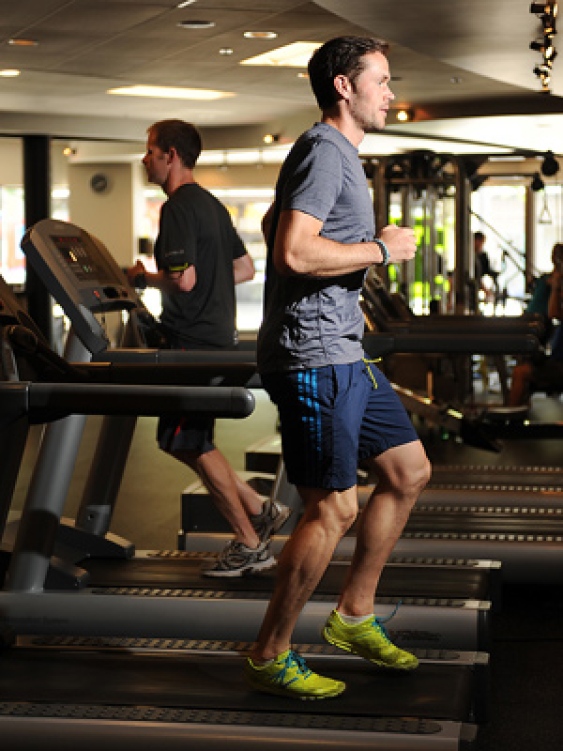
It may sound crazy, but one day at the gym, I decided to put the treadmill on a low speed and turn around. I started jogging backward, and eventually after a few mintues I was able to bump up the speed and pretty much run in reverse. I will admit it felt weird at first, but then I really started enjoying it. None of my joints were hurting, I wasnt running out of breath too quickly, and I was finally able to run for over 30 minutes without having any issues.

Now what are the benefits to running in reverse?
According to the New york Times Well blog and studies done by the University of Milan, running backwards can be easier on your joints, can help with muscle therapy, burn more calories, and increase balance. When running forward, a person puts a lot of tension and hard pounding on the knee joint. When running backward, however, there is much less hard pounding since our muscles and tendons act differently and instead of landing on our heels and taking off our toes like most people do when running forward, when running backward we land through our toes. Running backward also burns more calories because of the muscle and tendon activity. When running foward, we rely a lot of the motion and effort on the elastic energy in our muscles and tendons. When in reverse, this energy is not present, so we exert almost 30% more energy in order to run backward at the same speed. Our muscles are activated in order to stabalize our bodies in the backward motion which also helps improve our balance when moving both foward and backward and helps burns more calories.

When first implementing backward running, make sure to start off slow. It is a new motion for your body, and will take a little time to get used to. I currently only run backward at 4.5 mph on the treadmill to ensure safety, but also feel the benefits of the exercise. Trust me, after running backward for a few minutes, your calves and quads will be burning!

Try this exercise out and let me know what you think. Email me at corestrengthalec@gmail.com for any questions, comments, feedback, or ideas for future topics to discuss.

To view the New York Times Well blog article on reverse running, Click Here.

Feature Friday: Eric Turner

Eric 1
First name: Eric
Last name: Turner
City: Houston
State: Texas (Originally from Herriman, UT)
Age: 32
Height: 6’1″
Weight: 208
Profession: Personal Trainer

Follow Him:
Twitter: @erictastic
Instagram: erictastic

When did you start working out?:
When I was 21.

Eric 2

How many days a week do you work out?:
I do weights 5 days a week and I do cardio 6 days a week.

How long is your average workout?:
Usually 90 min

Favorite muscles to exercise:
Legs

Least favorite muscles to exercise:
Legs. lol

Eric 3

Do you have any fitness goals? If so, what are they?:
I’m constantly trying to better myself and my symmetry, and I’m currently competing for my IFBB Pro Card.

Do you have any fitness inspirations? If so, who are they?:
Jaco De Bruyn

What supplements do you take or recommend?:
I think people misunderstand what supplements are for. They are intended to supplement any areas that your diet is lacking. I tend to only take supplements when I’m dieting down so that I still get the nutients that I’m lacking.

Eric 4

Can you give a brief overview of your diet?:
It’s constantly changing, so that I won’t plateau. It generally consists of around 45-50% of kilocalories from carbs, 30-35% of kcal from proteins, and 15-20% of kcal from fats.

Do you have any workouts that you specifically like, that you believe are very affective?:
You can’t have a good physique if you focus too much on one thing. Variety is the spice of life when it comes to me working out. I have lately been obsessed with lateral raise drop sets though.

Do you have any tips for people who are trying to reach their fitness goals?:
Keep with it. Consistency is the magic ingredient!

Do you have any other things you would like to say?(Comments, suggestions, etc)?:
I get a lot of questions from people who have all sorts of strange ideas of things they’ve heard… I think the biggest misnomer that people have is that low carb is always the way to go. If you’re looking to build muscle, you can’t pack on muscle without eating carbs, and cutting them out actually makes gaining muscle pretty difficult.

BOSU Ball Squats

Bosu Ball Squat - Position 1

Bosu Ball Squat – Position 1

Want to tone your legs? Want to challenge yourself with something new… Try BOSU Ball Squats.

This exercise is excellent to activate all of the muscles in your upper legs and your core. It requires a lot of control and balance and is a bit harder than it looks. To perform a BOSU Ball Squat:

    1. Grab a BOSU ball and put the ball on the ground, leaving the flat surface up.
    2. Slowly place one foot at a time on the BOSU ball and stand up straight (You are now in Position 1).
    3. Slowly lower to a squat position by lowering your butt down and activating your quads (You are now in Position 2)
    4. Using your quads, hamstrings, and glutes, raise back up to a standing position (You should now be back in Position 1).
    5. Repeat for the recommended amount of reps (usually 12-20).
Bosu Ball Squat - Position 2

Bosu Ball Squat – Position 2

Tips:

    1. Remember, when doing squats, the general rule is “Ass to Grass!” Lower your butt down as far as you can. This full range of motion will help build and tone your legs muscles.
    2. In order to balance, really activate your core. This exercise is more than just a leg workout!
    3. Once you become comfortable, you can add a barbell to make the exercise harder. Rest the barbell behind your head on your shoulders and perform the exercise with this added weight. WARNING: Do not try to squat the same amount of weight on the BOSU ball that you normally do on the flat ground. Start off small and add weight slowly. You will be surprised how much harder the squat becomes on the BOSU ball.
    4. BE CAREFUL!!! It is easy to fall off the ball. If you need to, perform this exercise next to a wall or something else that you can hold to maintain your balance. Try and do the exercise without brasing yourself, but hold something when necessary… Safety is always the most important thing when exercising!

Do you like this exercise? Do you have any other exercises you would like to share? Any questions or comments? Contact me at corestrengthalec@gmail.com

Workout: Outside Body Weight Workout 4/6/13

When traveling, sometimes it is hard to really find the time and place to get in a good workout. Today we experienced exactly that. DO NOT LET THIS BE AN EXCUSE TO DO NOTHING!!!!! Right now I am in Albuquerque, New Mexico and the weather could not have been more perfect for a workout. With little time and little equipment, my fellow cast members and I put together a quick circuit training workout that we could do outside just using our body weight. All you need to perform this workout is a bench, wall, or other object that is a foot or two off the ground. Here it is:

Alec Varcas Circuit Training

20 pushups
20 tricep dips
15 burpees
15 box jumps
10 squats
60 second plank hold
Sprint around the pool

We did this circuit 5 times!

The goal was to do this as fast as possible with very little breaks. It doesn’t sound too hard when you read through the workout, but once you get your heart rate going and you really push yourself to finish quickly, you will definitely SWEAT and your muscles will be screaming!

TIPS:
1. If you have never done any of these workouts, please do proper research and make sure your form is correct and safe! I will be posting some techniques for these workouts in the near future, so keep an eye out.
2. Circuit Training workouts are great to do with a group of friends. Seeing others push themselves hard, only makes me want to push my limits too. Plus if you are competitive, you can see who is able to finish the workout first!
3. BRING WATER! Circuit training can be very hard and if you do not hydrate, you are chancing dehydration which is never a good thing!
4. Push yourself. If you find this workout too easy, make it harder! You can add 10 more pushups, 10 more box jumps, 10 more squats, or even add more workouts to the circuit!

After this workout I realized that I did have a little more time so I also did 3 sets of:
20 belt kicks
60 second side plank holds on each side
40 power squats
30 pushups

All of these workouts together make up a great, quick full body workout. I usualy like to focus on one or two muscle groups a day, but it is great to mix it once in a while. Circuit training provides great cardio while also building and toning your muscles.

Do you have any circuits you like to do? Sent them to me! Maybe I will try them out and post them :-). Do you have any other questions? Email me at corestrengthalec@gmail.com.