How to get the most out of your Calf Raises!

Calves2
Calf Raises can be done many ways; however, there are a few tips to understand and follow in order to get the most out of the exercise.

  • First of all DO NOT BOUNCE! When you bounce or do quick calf raises, the work is being done by your Achilles tendon, not your calf muscles. You may feel a burn in your calf muscle, but it is not being targeted well enough to see results.
  • Doing a slow controlled movement from a rest (standing) position to the balls of your feet will activate all of the muscles in your calves.
  • If calf raises are done with straight legs, all of the parts of the calf will be working, but most of the work will be done by the very visible, large muscle on the outer part of the calf (Gastrocnemius). This will promote thickness and definition of your calf. If calf raises are done with bent knees, the smaller muscle behind the Gastrocnemius (Soleus) will be doing most of the work. Now although the Soleus muscle is not as visible as the Gastrocnemius, because it is behind the larger muscle, it will cause the Gastrocnemius to swell and visibly pop out more. Both are beneficial so I like to alternate between bent and straight legs between sets.
  • Calf raises can be very effective with no weight; however if you are doing weighted calf raises, the same principle applies. Use slow controlled motions rather than a bouncing movement.
  • Another possible way to change up the exercise is doing calf raises on a ledge where your heels hang over the edge. When lowering, go past parallel with the floor and stretch your calf muscles more. This will give you a wider range of motion for the muscle; therefore working the muscle in a different, harder way.

The gym I currently go to has a Power Plate. I like to start off my calf routine with 3 sets of slow calf raises on the Power Plate, and then I do 4 sets of weighted calf raises on one of the calf machines. Do what works best for you, but make sure to follow these tips.

I hope you found this article helpful. If you have any questions, concerns, or ideas for other articles, please email me at corestrengthalec@gmail.com

Good Carbs vs Bad Carbs

goodandbadcarbs
I think most of us have heard the terms ‘good carbs’ and ‘bad carbs’ before, but do we actually know what they mean. To make it as simple as possible, ‘Good Carbs’ come from foods that also have a good source of fiber. For example, fruit, vegetables, whole grains, beans, etc. ‘Bad Carbs’ come from foods with little to no fiber content, such as white bread, white rice, etc. Fiber allows the body to slowly digest the carbs that we consume which leads to more stable blood sugar. If we eat food high in carbs and low in fiber, we quickly digest the carbs which then causes spikes in our blood pressure.
One other major thing to understand about good carbs and bad carbs is the composition of the carbs themselves. When carbs are digested, they are broken down into glucose (sugar) which the body needs for energy. During digestion, the body will break down any carb it is given into glucose; however, because of the fiber and other nutritional value with good carbs, the body is taking in more than just glucose. With bad carbs, the body is only quickly converting the carbs to glucose with no other vitamins or minerals to digest; therefore the calories being consumed can be considered ’empty’ calories and not beneficial.

The moral of the story is:
1. Stay away from foods high in carbs, but low in fiber.
2. It is healthy to eat ‘good carbs’ (aka. foods with vitamins, minerals, and fiber)

I hope this article helped. If you have any comments, questions, concerns, or ideas for other blog post, email me at corestrengthalec@gmail.com .

Is Shoveling Snow a Good Exercise?

shoveling-snow2
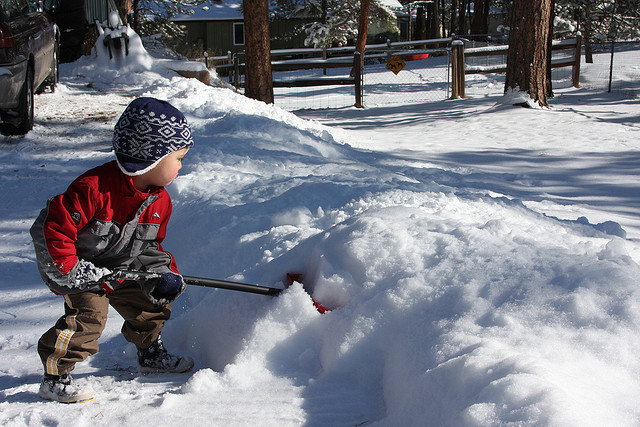
Because Winter is now upon us, and we are definitely starting to see some heavy snowfall, I wanted to see if shoveling snow was a good way to get some exercise. I personally always dreaded going outside and clearing the driveway of snow, but after doing some research, I realized that it definitely has its benefits. According to an article done by Julie Garden-Robinson, Ph.D., L.R.D, at North Dakota State University, a person of 170lbs can shovel for 30 minutes and burn about 250 calories. (Click Here to See the Article) Because shoveling involves high repetitions of lifting a weighted object, it also can help tone your muscles in your arms, legs, and core if done correctly. Not too bad for a chore I hate doing.

shoveling-snow

It is important to also understand the dangers of shoveling before you go out and start throwing the snow around. A quote from masslive.com stated,

“According to a study published in the American Journal of Emergency Medicine, some 195,100 Americans were treated in emergency rooms for snow shoveling-related mishaps from 1990 to 2006. Among those cases, 7 percent were cardiac related, which made up all of the 1,647 deaths in the study.”

Click Here to see the Article on Masslive.com

Here are some tips to keep in mind:

  • Because shoveling can involve some heavy lifting at times, it also puts some people at risk of heart attacks. If you already have high blood pressure or are at risk of a heart attack, consult your doctor before you decide to go outside and shovel snow.
  • Make sure to always lift with your legs and tighten your core when lifting the snow.
  • Avoid twisting and lifting from your lower back to avoid lower back injuries which are common when shoveling.

So next time you go out to battle the cold and shovel, try to think of how it actually can help you reach our fitness goals. As long as you stay smart and safe by following the tips I shared, shoveling will can be more than just a chore, but a productive workout.

How did you like this post? Did you find it useful? Do you have any other ideas for future posts I should do? If you have any questions, comments, or concerns, feel free to contact me at corestrengthalec@gmail.com.